 VisualCubing
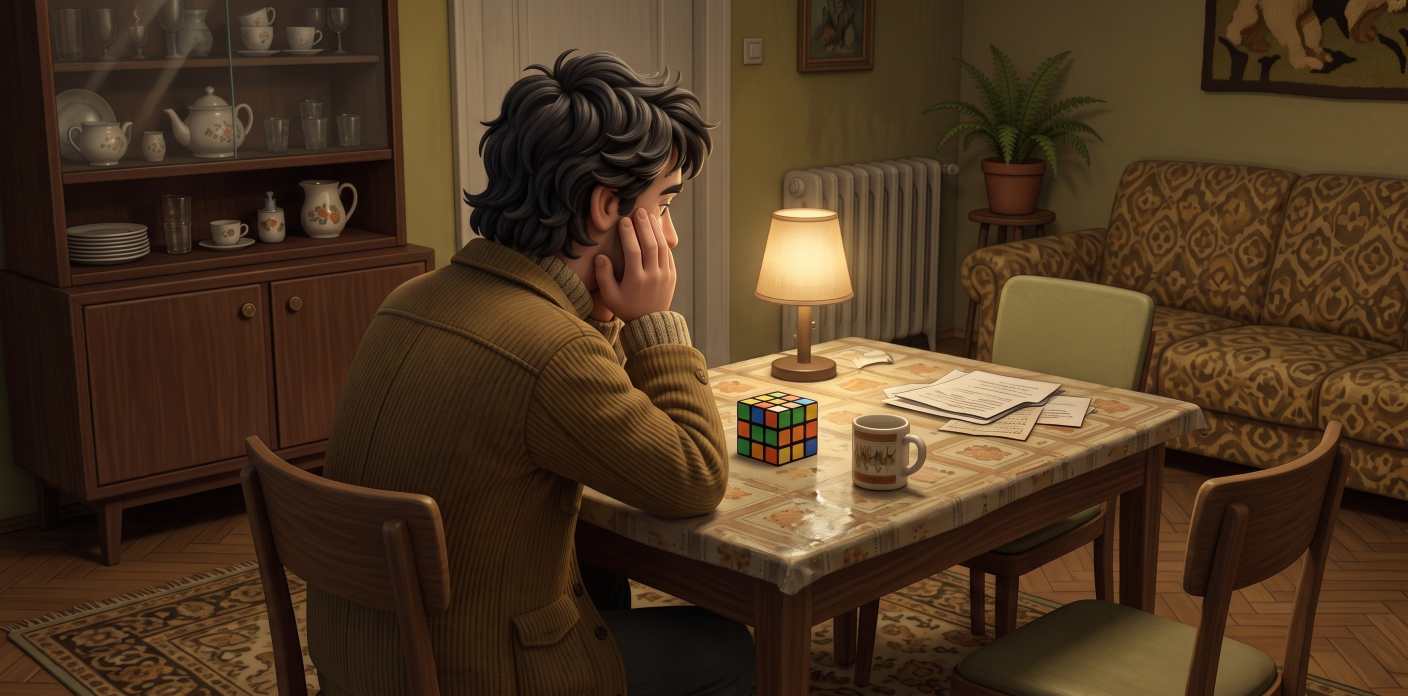
Ernő Rubik built the first cube in 1974 to explain three-dimensional geometry to his students. When he scrambled it for the first time, he discovered something uncomfortable: he didn't know how to get back. It took him over a month to solve it. It's worth starting there, because it's the first thing people forget: the cube wasn't born as a hard toy, but as a teaching aid that got away from its own author.
The teacher who got locked inside his own invention
Rubik taught design in Budapest, and what he set out to solve was a mechanical problem, not a riddle: how to make twenty-six pieces turn against each other without the whole thing falling apart. That part he solved. The riddle came later, by accident, the day he turned a few faces to see what would happen and found himself holding an object he couldn't undo.
What he did over that month is exactly what you do now: look for sequences that place a piece without ruining the ones already in place, try them, write them down, repeat them. Without knowing it, he was writing the first method in history, by hand and in the dark.
Forty-three quintillion positions and a single solution
And it’s no ordinary puzzle. A 3×3 has 43,252,003,274,489,856,000 distinct positions — forty-three quintillion — and only one is solved. If you’d started turning it the day of the Big Bang, one new position a second, you still wouldn’t have seen even one per cent. And yet, from any of them you get back to the good square in twenty moves or fewer. Always. That number took decades to prove; turning the cube with a method is by far the easy part.
That twenty has a name: they call it God's number, and it was proved in 2010 by splitting the computation across a huge number of machines. The lovely thing about the result is how useless it is in practice: it proves the short path exists, but it doesn't tell you what it is. That's why the methods we humans use solve in fifty or sixty moves rather than twenty — they're built to fit in a head, not to be optimal.
The eighties, when half the world got stuck
In the eighties the toy left Hungary and became a worldwide phenomenon: hundreds of millions of units sold and an entire generation wrestling with six colored faces. Almost nobody managed it. But a few started writing down sequences that always worked, and that's how methods were born: repeatable recipes that turn an impossible puzzle into something you can learn.
In 1982 the first world championship was held in Budapest, and Minh Thai won it with 22.95 seconds. Keep that number in mind, because today twenty-three seconds is roughly what a steady hobbyist does with an intermediate method. What made you the best in the world in 1982 is an ordinary afternoon now.
From notebooks to a common language
Sharing those sequences needed one more thing: a way of writing them that meant the same in Budapest as in California. That's how notation appeared, those letters that look like hieroglyphs at first and are really just the names of the six faces. That's what turned a toy into a language: from then on, an algorithm someone found at home could travel and work exactly the same in anyone else's hands.
Today: a whole community, and three seconds
Today there's a whole community around it. Official WCA competitions in over a hundred countries, one-handed, blindfolded or feet categories, and a solving record under three seconds. What took Rubik a month now happens in the blink of an eye.
And between that month and those three seconds there's no trick: just fifty years of people writing down what worked and handing it to the next person. Learning it today is joining that chain wherever you like.