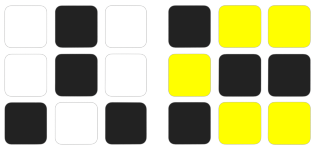
 VisualCubing
The cube that turns with your finger
Before we explain anything, touch it: it's a real 3D cube, with genuine standard notation, no shortcuts. Try any move, paste a formula you already know into Your formula to check if it really solves what it promises, or press Scramble cube and practice blind, like in a real competition. Turn it, break it — it can't be ruined, that's exactly what it's for.
Practice it here
Press any move and watch the cube turn. Drag to rotate the view whenever you want.
Patterns are notation's showcase side: a short formula that turns the solved cube into a picture. Pick one and watch it build — or come undone.
Type or paste the formula and press ▶ to play it as is, or Prepare cube (reversed) to leave the cube at its starting point and watch it actually solve. Standard notation: R R' R2, wide r u f d l b, M E S, cube rotations x y z. Rw/Uw also works if you copied it from somewhere else.
30 random moves, like a competition scramble. Press Scramble cube to generate a new one and get the player ready to solve it.
What each control does
Get to know the cube
Now for the important part: what pieces it's made of, what each face is called, and how to read any formula on this site. Ten minutes and you won't forget it.
The cube, inside and out
Before the first formula there are two things to know: what pieces the cube is made of, and what each face is called based on its orientation. With that, you can already read any algorithm on this site.
The pieces
A 3×3 isn't 54 loose stickers: it's 26 pieces mounted on a central axis, of three types, and each type behaves differently.
Corner
Three stickers. Lives in a corner and can only go to another corner: it will never be an edge. It can be in its place but twisted.
Edge
Two stickers. Occupies the midpoint of each border. Just like the corner, it only travels to edge positions.
Center
One sticker, and the key piece: it's anchored to the axis, so it spins in place but never moves.
The faces and their names
The six faces are named after the initial of their position in English, not their color. This is the first thing to internalize: R doesn't mean red, it means the right-hand face, whatever color it happens to be.
You see U, F and R. The other three are behind,
in the direction their letter points.
The colors in the box are the ones this site uses, but your cube might have them arranged differently. What never changes is the position: the top face is U even if it's blue.
Turning the cube changes the faces but not the orientation
This is where most people get lost. The letters that define orientation aren't tied to colors or space: they're oriented toward you. If you turn the whole cube a quarter turn, the face that was R becomes F, and the one that was behind becomes R. That's why so many algorithms start with “place this piece in front”: they're asking you to redefine where F is.
It's solved layer by layer
Almost every method attacks the cube in horizontal slices, called layers. You complete one and move to the next without undoing it. In grey, what doesn't matter yet.
First layer
The bottom layer, complete with the sides matching. It's the most intuitive and the one most often solved by reasoning.
Second layer
The middle layer: just four edges, with two mirror formulas. This is where the first real algorithms appear.
Third layer
The top layer, the most involved: first it's oriented (OLL) and then placed in position (PLL).
How to hold the cube
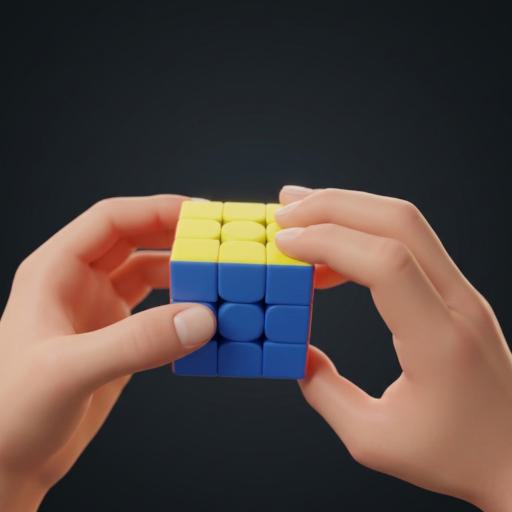
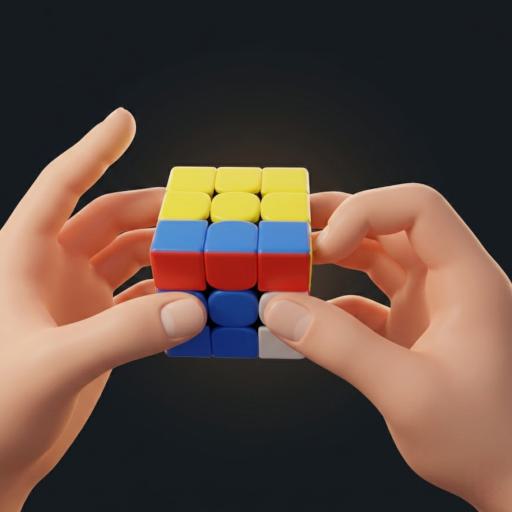
You hold it with both hands, keeping one face fixed in front throughout the algorithm. Your index fingers do the turns on the top faces; your middle and ring fingers hold it steady from behind so the cube doesn't wobble. The less you reposition the cube between moves, the faster you'll go.
The most common blocks
Long algorithms aren't memorized letter by letter: they're memorized in blocks. These four show up over and over, and once you have them in your fingers, everything else gets much easier.
Sexy move
The most used block on the cube. It shows up in the first layer, in the yellow cross, and inside half the OLLs. Repeated six times it returns the cube to its starting state.
Anti-sexy move
The same block read backwards. It undoes exactly what the previous one does, which is why it usually closes algorithms that start with it.
Sledgehammer
The hammer. Moves a few pieces around without touching almost anything else, so it's the fine-tuning tool for the last layer.
Hedge Slammer
The hammer read backwards, starting with F instead of R'. It often shows up right after a Sledgehammer, as its natural partner.
Common beginner mistakes
These six are what most often make someone quit in the first week — and all of them are about mechanics, not lack of talent. If any of these sound familiar, it's not that you're bad at it, it's that nobody had explained it this way yet.
Confusing the letter with the color
R doesn't mean “red,” it means “the right-hand face.” If you memorize by color, the day you turn the cube or pick up another one with a different layout, everything stops fitting.
Losing track of which one is F
After a whole-cube rotation (x, y, z), the face that was in front of you stops being F. Still thinking of the old F is the number one source of confusion.
Not telling uppercase from lowercase apart
R turns one layer; r turns two at once. Applying the algorithm with the wrong layer undoes exactly what you were achieving.
Skipping the apostrophe when reading
R and R' are opposite turns. An overlooked apostrophe turns a correct algorithm into a more scrambled cube.
Memorizing letter by letter instead of in blocks
R U R' U' isn't four separate moves: it's the sexy move, a block. Memorizing it as a word instead of a list is what makes it stick.
Not reorienting the cube between repetitions
Many algorithms ask you to reposition the cube before repeating them (turning the U layer, or the whole cube). Skipping that step is the classic cause of “this is supposed to work and it doesn't for me.”