 VisualCubing
Pyraminx notation explained
The Pyraminx turns on 4 axes instead of 3, and each turn is 120° instead of 90° — but the idea is the same as on the cube: one letter per axis, an apostrophe to reverse it.
Try it yourself
Turn the Pyraminx with your finger, press the moves or type your own formula.
Patterns are notation's showcase side: a short formula that turns the solved Pyraminx into a picture. Pick one and watch it build — or come undone.
When you set it up, the Pyraminx applies the formula backwards: that way you see exactly the case it solves.
WCA-style scramble: 8-11 corner turns without repeating an axis back to back, plus up to 4 loose tip turns.
What you need to know
How to hold it
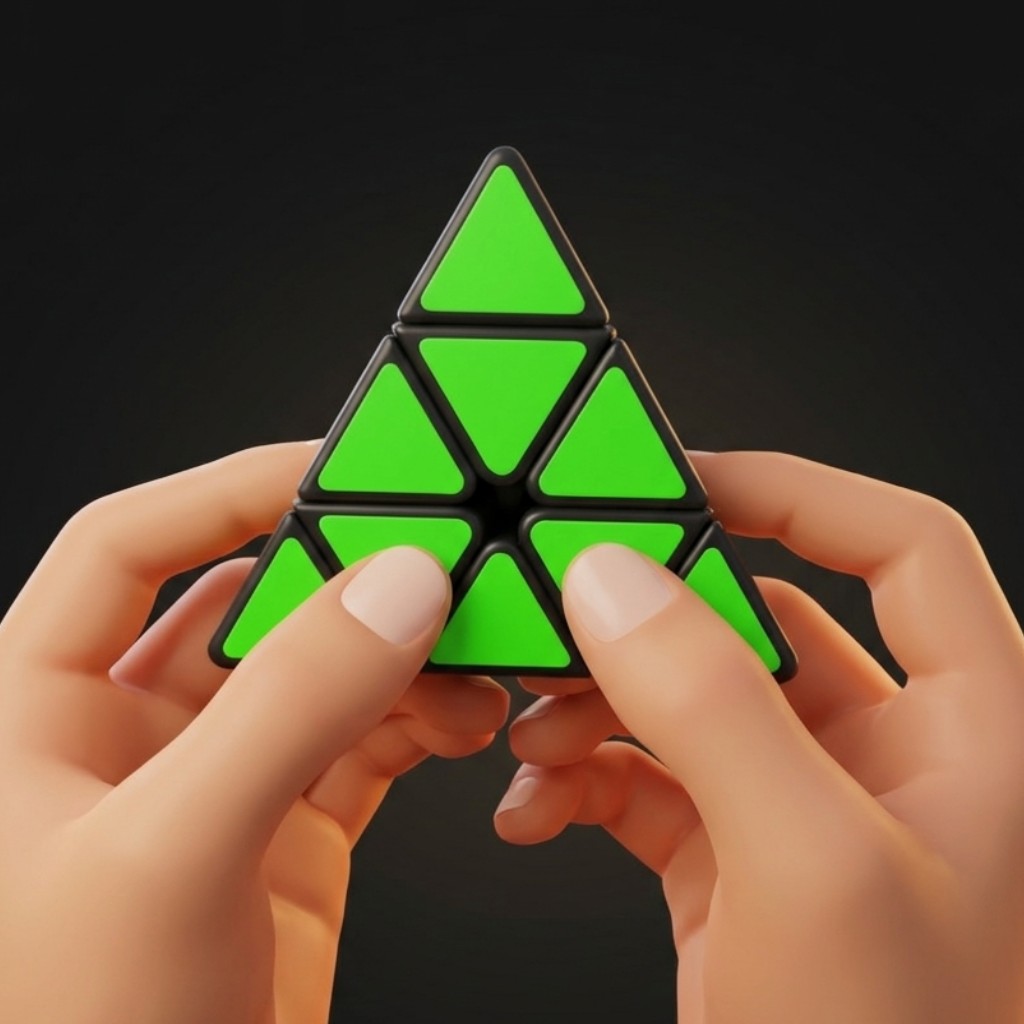
The Pyraminx is held with both hands by two of its vertices: your thumbs and index fingers stay free to turn the corners without repositioning it between moves. It's a steadier grip than the cube's —two tips instead of six faces— and it's what lets you chain turns so fast: the world record is under a second.
The Pyraminx pieces
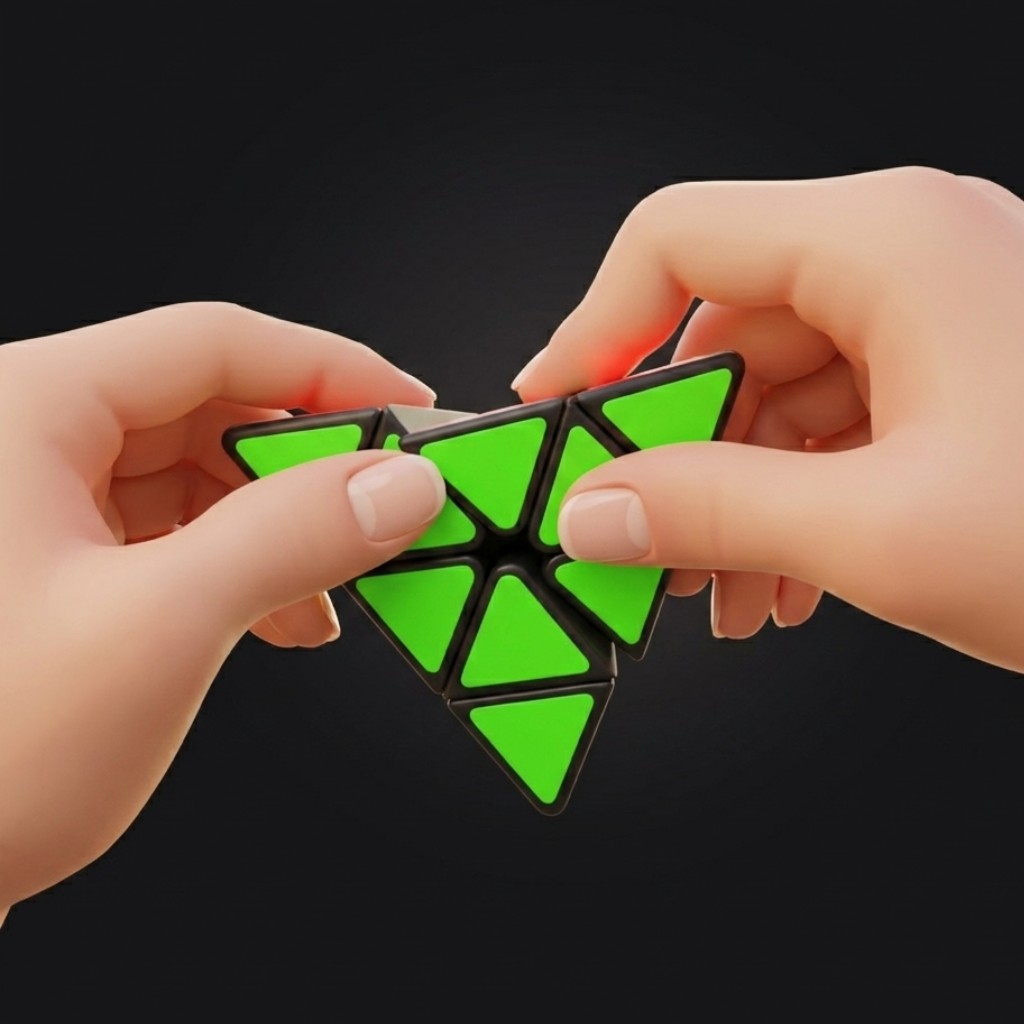
14 pieces in all, of three types — and not one of them behaves like the pieces of a cube. Each drawing highlights every piece of its type.
Corner
The loose tip of each vertex. It turns on its own (with the lowercase letter) and a misoriented corner affects nothing else: that's why it's the first step of every method.
Edge
Like on the cube: two stickers, one for each face it touches. It can't just change places — only be positioned and flipped.
Centre
The piece sitting under each corner. It can't be moved anywhere else: the four centres define the Pyraminx's orientation, just like the centres of a 3×3.
The colour scheme
With yellow on the bottom and green in front there are still two possible Pyraminxes, and they're mirror images. Ours has red on the left (L) and blue on the right (R), the one most of them are sold with. It's no small detail: in the mirror, every formula looks like it turns the other way.
So what now?
With the notation clear, the next step is solving it. The Pyraminx has the fastest learning curve on the site: sub-30 seconds in about an hour.