 VisualCubing
You're practising a new algorithm, you've got the cube in both hands, and your phone goes dark. You unlock it with your little finger, go back to the screen, and you've lost your place. Four times in a row. It's such a silly problem that it's infuriating, and it's why a lot of people who are serious about this keep a sheet of paper next to the cube as well.
The screen to understand it, paper to drill it
They're two different stages and they ask for different things. When you're learning a new case you need to see it: the cube turning, the algorithm in slow motion, the pieces that don't matter greyed out, and the whole thing repeated until you understand what each turn is moving and why. No sheet of paper gives you that, however well made, and that's what the interactive cube on every method page is for.
Once you've understood it and it's time to put the repetitions in — twenty, fifty, however many it takes until it comes out on its own without thinking — what you need then is a reminder, a glance, while your hands never let go of the cube. And that's usually more comfortable on a sheet than in an interface.
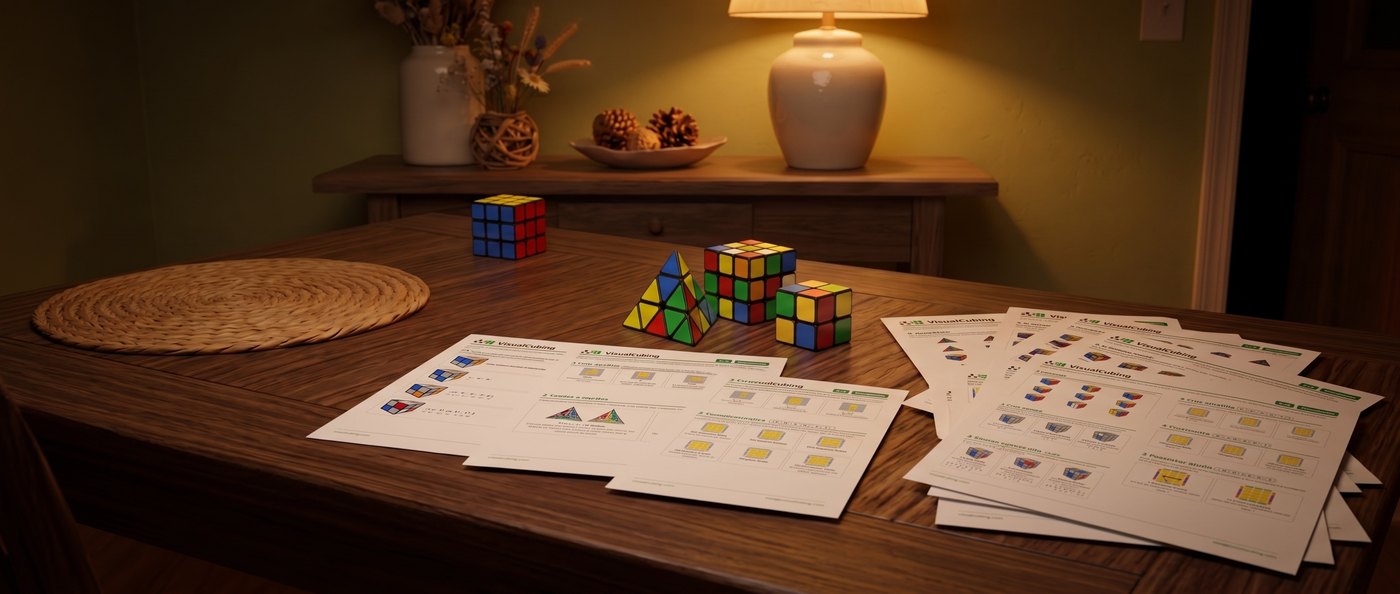
That's why we built the printable sheets. They carry the same information: you learn on the site and you get faster with the sheet beside you.
Thirteen sheets, six puzzles
There's one sheet per method: the three for the 2×2, the three for the 3×3, Reduction for the 4×4 and the 5×5, the three for the Pyraminx and the two for the Skewb. Each one carries every algorithm in that method, with the same cube diagram you see on the site next to each of them, so you never have to work out from memory which case a sequence belongs to.
It's not a PDF somebody uploaded three years ago
This matters more than it sounds. The sheet isn't a file that was generated once and left there: it's built on the spot, from the same algorithms and the same icons you're looking at on the page. If we fix an algorithm or change an icon one day, the sheet comes out fixed that same afternoon — there's no old copy going around saying something different from the site. And it comes out clean: no ads, no watermarks and nothing in the way right where your thumb rests. Just visualcubing.com in the footer, in case somebody finds it photocopied on a table and wants to know where it came from.
Free, no sign-up and no email
There's no form, no "leave us your email and we'll send it over", no account to create. You go to Downloads, tap the method you want and the print menu opens straight away, where you can send it to the printer or save it as a PDF. It works from a phone too. And they're in all eight languages of the site, so if you study in Basque or in German the sheet comes out in Basque or in German, not in English.
If you teach a class or run a club, take them with you
If you teach a group, print them and hand them round. That's the use we had in mind while we were making them: a stack of sheets on the table so everyone has their own, and the projector or the tablets for the case that everyone gets stuck on. If you use them that way and something's missing, say so — that's where the best corrections come from.