 VisualCubing
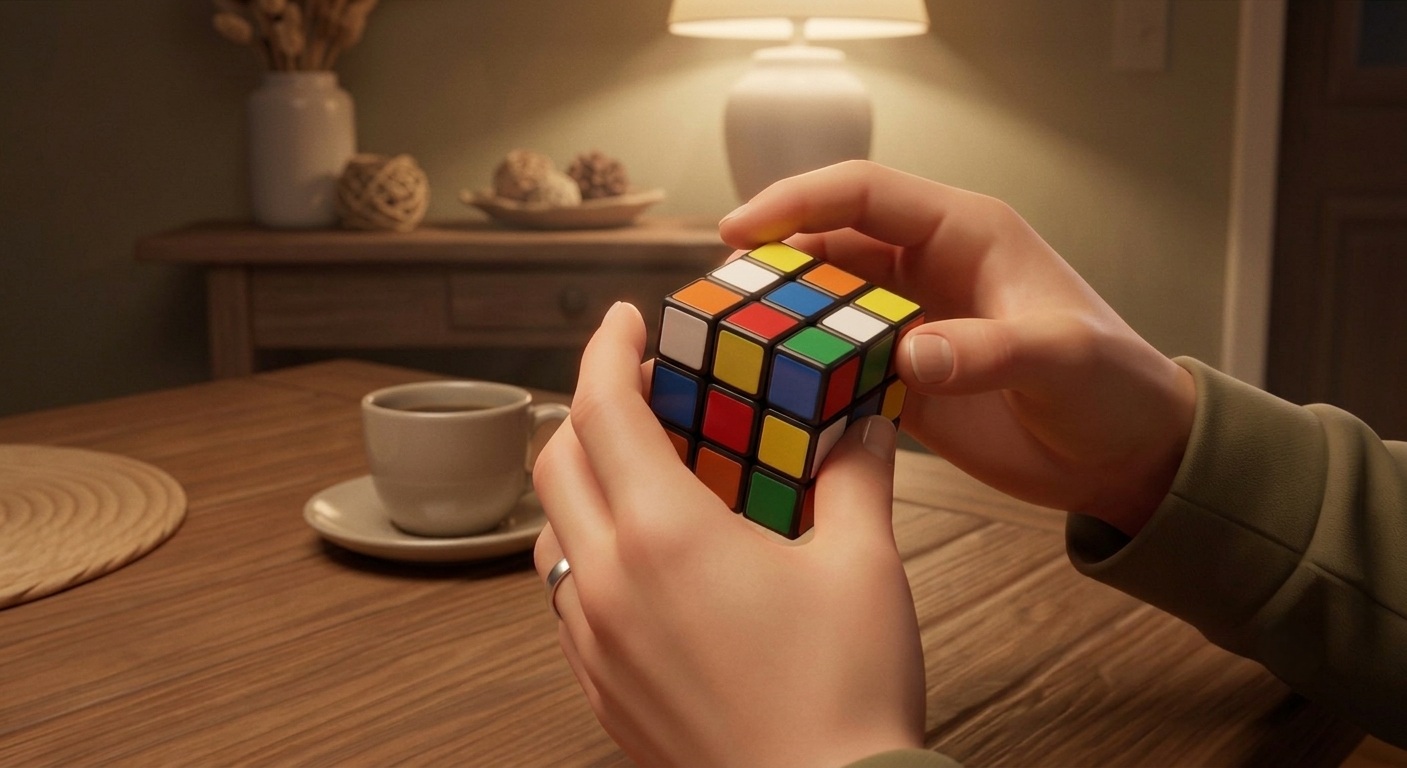
Let's get something out of the way first: Ernő Rubik, the man who invented the cube, took over a month to solve his own for the first time. He built it himself, with his own hands, to explain geometry to his students — and yet, the moment he scrambled it, he found himself staring at it exactly the way the rest of humanity would stare at it for the next fifty years: with absolutely no idea where to start.
If you've got a cube gathering dust in a drawer, and every time you pick it up you give it two twists, sigh, and put it back down — congratulations, you're in good company. Including the inventor's.
The cube doesn't resist you specifically. It resists everyone, at first
Here's the part almost nobody tells you: the Rubik's Cube isn't an intelligence test. There's no "spark" that some people have and others don't. It's, quite literally, a recipe — a sequence of moves you repeat until it sticks, like dance steps. The gap between "I have no idea" and "oh, this is actually really easy" isn't an IQ leap: it's one well-spent Saturday afternoon.
And if, at some point in your childhood, you peeled off a sticker to "cheat" — no judgment here. We've all been there. It's practically a rite of passage.
Your first solved face isn't a small win
There's a very specific moment, the first time someone solves a full face of the cube, when something curious happens: they smile to themselves. With nobody watching. That rush isn't a coincidence or you overreacting — it's real chemistry: your brain releases dopamine at every small goal met, not just at the very end. That's why the cube doesn't feel like "one reward at the end of the effort," but like a staircase of small rewards, one after another.
And that's honestly the good kind of trap the cube sets: the moment you solve your first face, you already want the second. And with the second, you want to know what that "layer" everyone talks about actually is. And so on.
Why every level hooks you more than the last
A beginner needs to memorize between 5 and 7 formulas to solve the cube for the first time. An advanced speedcuber, using methods like CFOP, handles over 100. That gap shouldn't scare you — it should reassure you: it means there's an entire path between "I have no idea" and "I solve it in seconds," with steps designed so each one leans on the last. Nobody jumps straight to step 100.
What's interesting is what happens along the way: it's not that you get bored of solving it and that's why you level up. It's the opposite. The easier what you already knew becomes, the more you want to make your life a little harder. It's the same reason someone who already breezes through an easy Sudoku will, one day, with nobody forcing them, download a "fiendish" one.
It's not just a toy: what your head gains
There are studies linking the ability to solve the cube with abstract reasoning and spatial awareness — the same skills engineering degrees demand. And in children those same benefits — concentration, patience, fine motor skills — show up even faster, with nobody having to convince them of anything: we cover it in detail here. In older adults, practicing it regularly has been linked to real improvements in mood and dexterity. We've dedicated a whole post to this (concentration, patience, self-improvement and that "sixth sense" of knowing where your piece is without looking) — here it is, if you want the full story, names and all.
The community nobody expects to find
Here's what surprises almost everyone who gets hooked: you thought you were learning a party trick, and suddenly you find an entire global community. Official competitions in over a hundred countries, one-handed categories, blindfolded, with your feet. And a world record that's already broken the three-second barrier — 2.76, to be exact, held by a nine-year-old. People who meet at their first competition and end up friends for life, just from sharing the same healthy obsession.
You don't need to get anywhere near that. But it's good to know that, if it hooks you, there's a whole world waiting on the other side — not a closed club, but people who remember exactly what it feels like to have no idea, because they were right there not that long ago.