 VisualCubing
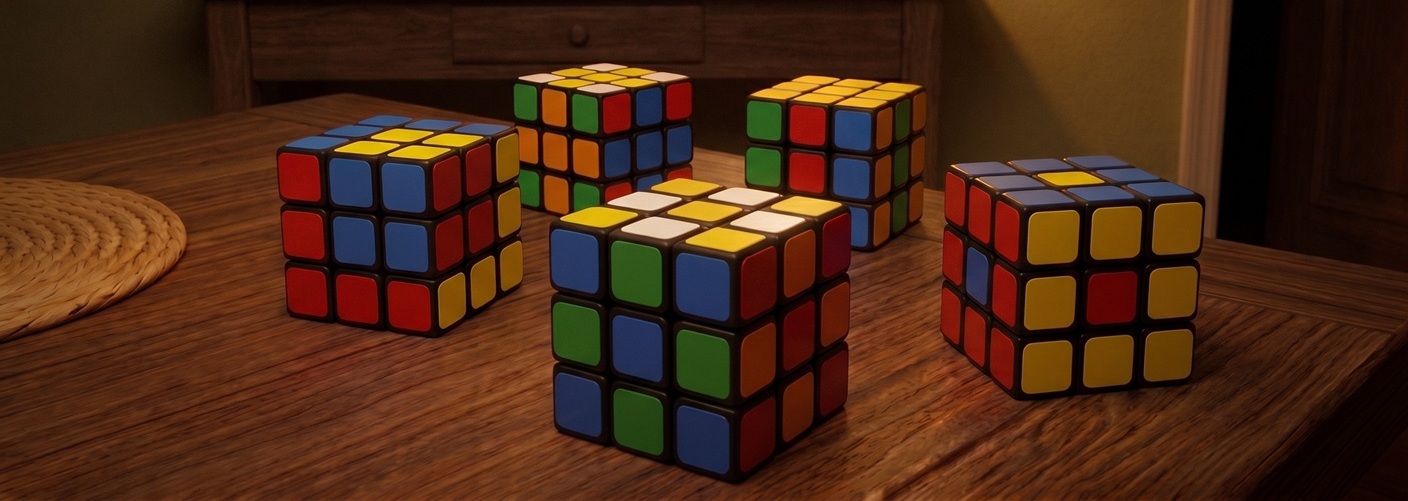
Leave a solved cube on the table and let someone scramble it without looking, and you get some random mess: one out of 43 trillion possible positions, with nothing special about it. But there's a handful of those positions that aren't random at all — they're pictures. And unlike a scramble, you reach them on purpose, with one specific formula, always the same, always the same result.
Checkerboard, the classic of all classics
The best known of all is the checkerboard: every face ends up looking like a chessboard, with corners of one color alternating with the rest of the pieces. It looks hard to pull off, but the formula is six double turns, one per face — nothing you can't run through in a few seconds.
Dots, crosses, and a cube inside a cube
There are dot patterns (four or six, depending on the formula) where the rest of each face turns a single color and only a few pieces stand out like freckles. There's a cross that literally draws a cross of one color over a background of another on every face. And then there's the most theatrical one of all, cube-in-cube: from the outside it looks like a smaller cube is floating on top of a bigger one — there's even a version with a third cube nested inside.
Superflip, the most famous position in the community
If the checkerboard is the prettiest, superflip is the most important. It's the position where every piece is in its own spot but every edge is flipped the wrong way — visually it looks broken, not solved, even though every sticker is exactly where it should be. For years it was the reference mathematicians used to talk about "God's number": proof that positions exist which genuinely need the maximum twenty moves to solve.
Stripes and a snake, for when you already know the classics
There are also vertical stripes that cross the three visible faces like blinds, and a snake that winds from face to face with no clean geometric pattern at all — the oddest of the collection, and exactly why it's the favorite of anyone who's already grown tired of the others.
You don't need to memorize any of this
None of these formulas need to be typed by hand or memorized: the Notation page has a Patterns tab that rebuilds the solved cube and applies whichever one you pick with a click. And if you like it, there's a button to undo it and put everything back the way it was, no manual work required.
The 4×4 and 5×5 have their own pattern collections — not the same ones from here scaled up, genuinely different formulas — and the Pyraminx has its own too, simpler but just as fun. Worth poking around all three if this got you hooked.